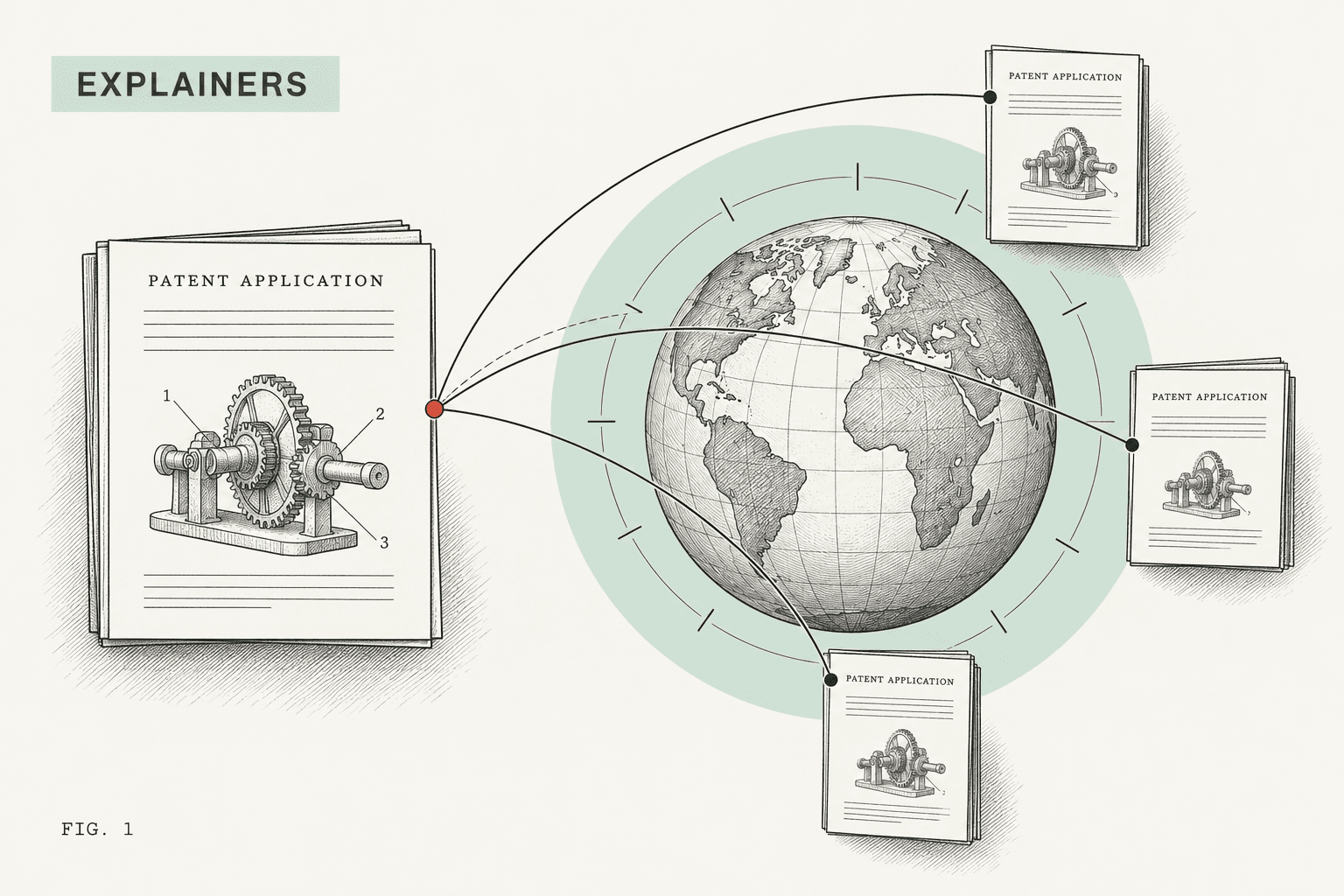
The priority year is the 12-month period that Article 4 of the Paris Convention for the Protection of Industrial Property gives an applicant, after a first patent application in one member country, to file in the others while relying on the first filing’s date. It lets an applicant file once, in one country, and take a year to decide where else to seek protection, without the inventor’s own publication or a competitor’s filing in the meantime counting against the later applications. More guides to the basics are on the Explainers hub.
What does Article 4 of the Paris Convention provide?
The Convention dates from 20 March 1883 and was last revised at Stockholm on 14 July 1967 and amended on 28 September 1979. Article 4A(1) gives anyone who “has duly filed an application for a patent, or for the registration of a utility model, or of an industrial design, or of a trademark, in one of the countries of the Union,” or their successor in title, “a right of priority” for filing in the other countries. Any filing equivalent to a regular national filing qualifies, and a regular national filing is one adequate to establish its filing date, “whatever may be the subsequent fate of the application” (Article 4A(2) and (3)).
Article 4C(1) sets the periods: “twelve months for patents and utility models, and six months for industrial designs and trademarks.” Under Article 4C(2) they “start from the date of filing of the first application; the day of filing shall not be included in the period.” If the last day is an official holiday or a day the office does not accept filings in the country where protection is claimed, Article 4C(3) extends the period “until the first following working day.”
What does priority protect against?
Events between the first filing and the later ones. Article 4B provides that a later filing within the period “shall not be invalidated by reason of any acts accomplished in the interval, in particular, another filing, the publication or exploitation of the invention,” and that such acts “cannot give rise to any third-party right or any right of personal possession.” Rights a third party acquired before the date of the first application are left to each country’s law.
In practice the priority date replaces the filing date for prior art. Under Article 89 EPC, “the date of priority shall count as the date of filing of the European patent application” for the novelty provisions in Article 54(2) and (3). Under 35 U.S.C. § 119(a), a U.S. application filed within the period “shall have the same effect as the same application would have if filed in this country on the date” of the first foreign filing.
Which first filings qualify?
A first filing in or for a Paris Convention country and, in the systems that provide for it, a first filing in or for a World Trade Organization member. Article 2(1) of TRIPS provides that “In respect of Parts II, III and IV of this Agreement, Members shall comply with Articles 1 through 12, and Article 19, of the Paris Convention (1967).” The European and U.S. texts both cover WTO members: Article 87(1) EPC covers a first filing “in or for” any Paris Convention state or any WTO member, with “a right of priority during a period of twelve months from the date of filing of the first application,” and § 119(a) covers a first filing in a country giving similar privileges to U.S. applicants “or in a WTO member country.”
International applications follow the Paris rule. Article 8 of the Patent Cooperation Treaty lets an international application claim the priority of earlier applications filed in or for any Paris Convention country, with the conditions and effect “as provided in Article 4 of the Stockholm Act of the Paris Convention,” although where the earlier application was filed in or for a designated state, the national law of that state governs them there. PCT Rule 4.10(a) extends the priority claim to earlier applications filed “in or for any Member of the World Trade Organization that is not party to that Convention.”
Which application counts as the first?
The earliest one for the same subject matter, with one exception. Under Article 4C(4), a later application in the same country is treated as the first if, when it is filed, the earlier one “has been withdrawn, abandoned, or refused, without having been laid open to public inspection and without leaving any rights outstanding, and if it has not yet served as a basis for claiming a right of priority.” The earlier application can then never serve as a basis for priority. Article 87(4) EPC repeats the rule.
Can one application claim several priorities?
Yes. Article 4F bars any country from refusing a priority or an application because it claims multiple priorities, “even if they originate in different countries,” or because it adds elements not in the earlier applications, provided there is unity of invention “within the meaning of the law of the country.” The added elements get their own priority from the later filing “under ordinary conditions.” Article 88 EPC allows multiple priorities, where appropriate for one claim, runs time limits from the earliest priority date, and limits the right to “those elements of the European patent application which are included in the application or applications whose priority is claimed.”
The earlier application does not need to have claimed the element. Article 4H, which Article 88(4) EPC repeats, provides that priority may not be refused because elements do not appear among the claims of the first application, “provided that the application documents as a whole specifically disclose such elements.”
What formalities does a priority claim need?
A declaration of the earlier filing’s date and country, under Article 4D(1), with each country setting the latest date for it. A country may also ask for a certified copy of the earlier application, which may be filed without fee within three months of the later filing (Article 4D(3)). The consequences of failing a formality “shall in no case go beyond the loss of the right of priority” (Article 4D(4)). In the United States, § 119(b)(1) requires a claim identifying the foreign application by number, office or country and filing date, at the time the Director sets.
Does priority extend the patent term?
No. Article 4bis(5) provides that “Patents obtained with the benefit of priority shall, in the various countries of the Union, have a duration equal to that which they would have, had they been applied for or granted without the benefit of priority.” U.S. law says the same in 35 U.S.C. § 154(a)(3): priority under § 119 “shall not be taken into account in determining the term of a patent.” Under § 154(a)(2) the U.S. term runs from the later application’s U.S. filing date, or from the earliest application it claims under §§ 120, 121, 365(c) or 386(c), not from the priority date, as the companion explainer on how long a patent lasts sets out.
Article 4bis also makes patents for the same invention in different countries independent of one another, an independence it says applies to patents applied for during the priority period “both as regards the grounds for nullity and forfeiture, and as regards their normal duration.”
What happens if the 12 months are missed?
Some systems allow a short cure. Under PCT Rule 26bis.3, where an international application is filed within two months after the priority period expired, the receiving Office restores the right of priority on request “if the Office finds that a criterion applied by it” is met: that the failure “occurred in spite of due care required by the circumstances having been taken” or “was unintentional.” Each receiving Office applies at least one of those criteria. The request must state the reasons and be filed within two months of the end of the priority period (earlier if early publication was requested), and the Office may charge a fee.
A restoration does not bind every country in the same way. Under Rule 49ter.1, one based on due care is effective in each designated state, but one based on unintentional delay is effective only in states whose law allows that criterion or a more favourable one, and a designated state can find the requirements were not met. Rule 49ter.2 also lets a designated Office restore priority itself on a request filed within one month of the national-phase time limit. Under Rule 26bis.3(j), the receiving-Office rule does not apply where national law was incompatible with it on 5 October 2005 and the Office told the International Bureau so by 5 April 2006, for as long as the incompatibility lasts.
In the United States, § 119(a) lets the Director provide by regulation for the 12 months to be extended “by an additional 2 months if the delay in filing the application in this country within the 12-month period was unintentional,” and § 119(e)(1) does the same for the 12 months after a provisional application. Under the USPTO rule, 37 CFR 1.55(c), the right of priority “may be restored” on petition where the later application is filed within those two months and the delay was unintentional.
Under the European Patent Convention, a request for re-establishment of rights for the priority period must be filed “within two months of expiry of that period” (Rule 136(1) EPC), and Article 122(1) EPC requires that the deadline was missed “in spite of all due care required by the circumstances having been taken.”
Without a valid priority claim, the later application is judged at its own filing date, so publications in the interval, including the applicant’s own, can count against it. The explainer on patentability covers the limited grace periods that may still apply.
Documents
- Paris Convention for the Protection of Industrial Property (as amended on September 28, 1979)
WIPO Lex, official translation TRT/PARIS/001; priority is Article 4
- TRIPS Agreement, Part I: General Provisions and Basic Principles
Article 2(1), compliance with the Paris Convention
- Regulations under the PCT, Rule 26bis
Restoration of the right of priority, Rule 26bis.3
- European Patent Convention, Articles 87 to 89
Priority right, claiming priority, effect of priority right
- 37 CFR 1.55, Claim for foreign priority
Restoration of the right of priority, § 1.55(c)
- 35 U.S.C. § 154, Contents and term of patent
Priority not counted toward term, § 154(a)(3)

Staff · Patent decisions, prosecution practice and AI in patent work
Stories under this byline are reported from the primary documents: Federal Circuit opinions, PTAB decisions, USPTO notices and European rulings.
Read more from EditorSpotted an error? Read our editorial standards and corrections policy, or send us a tip.