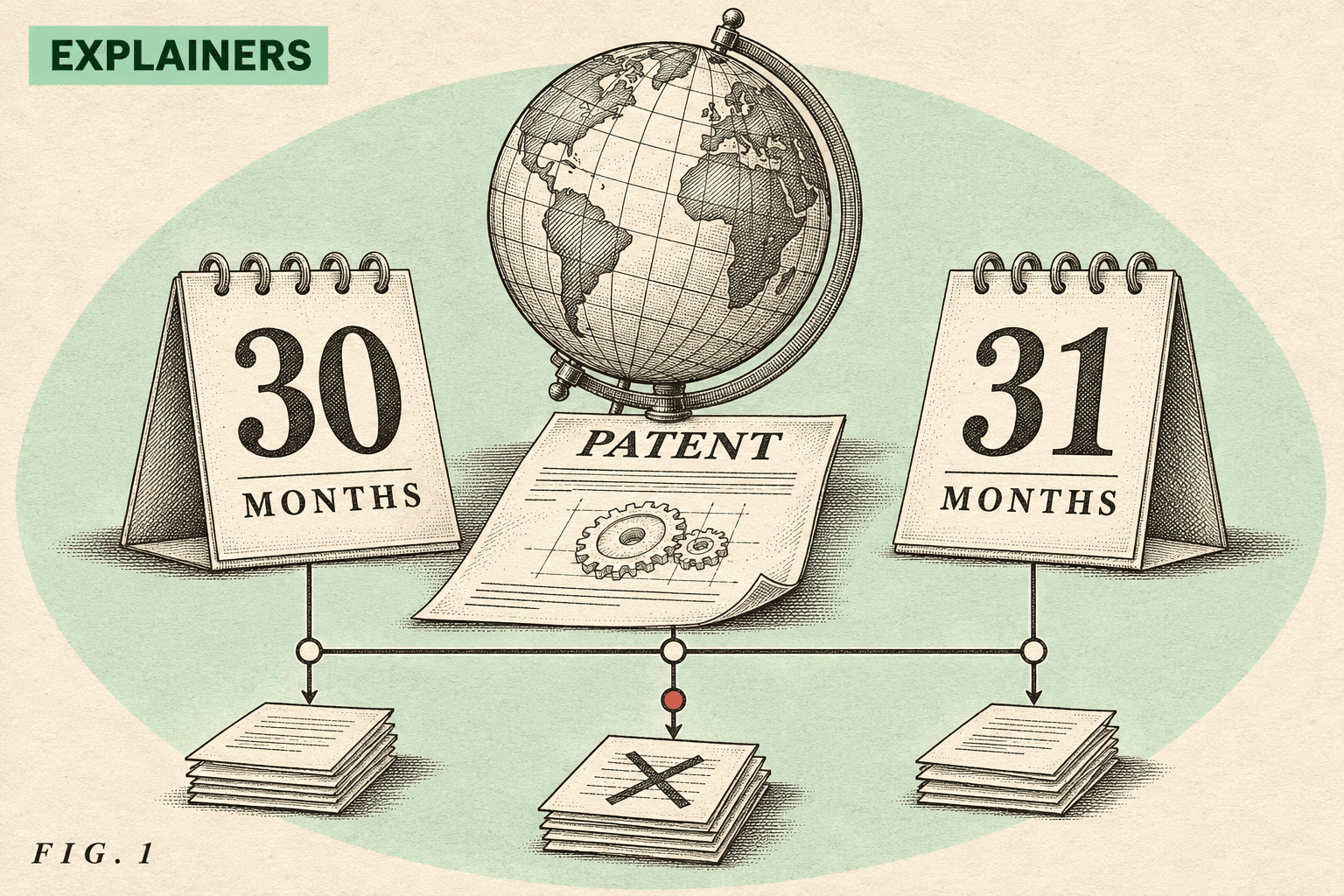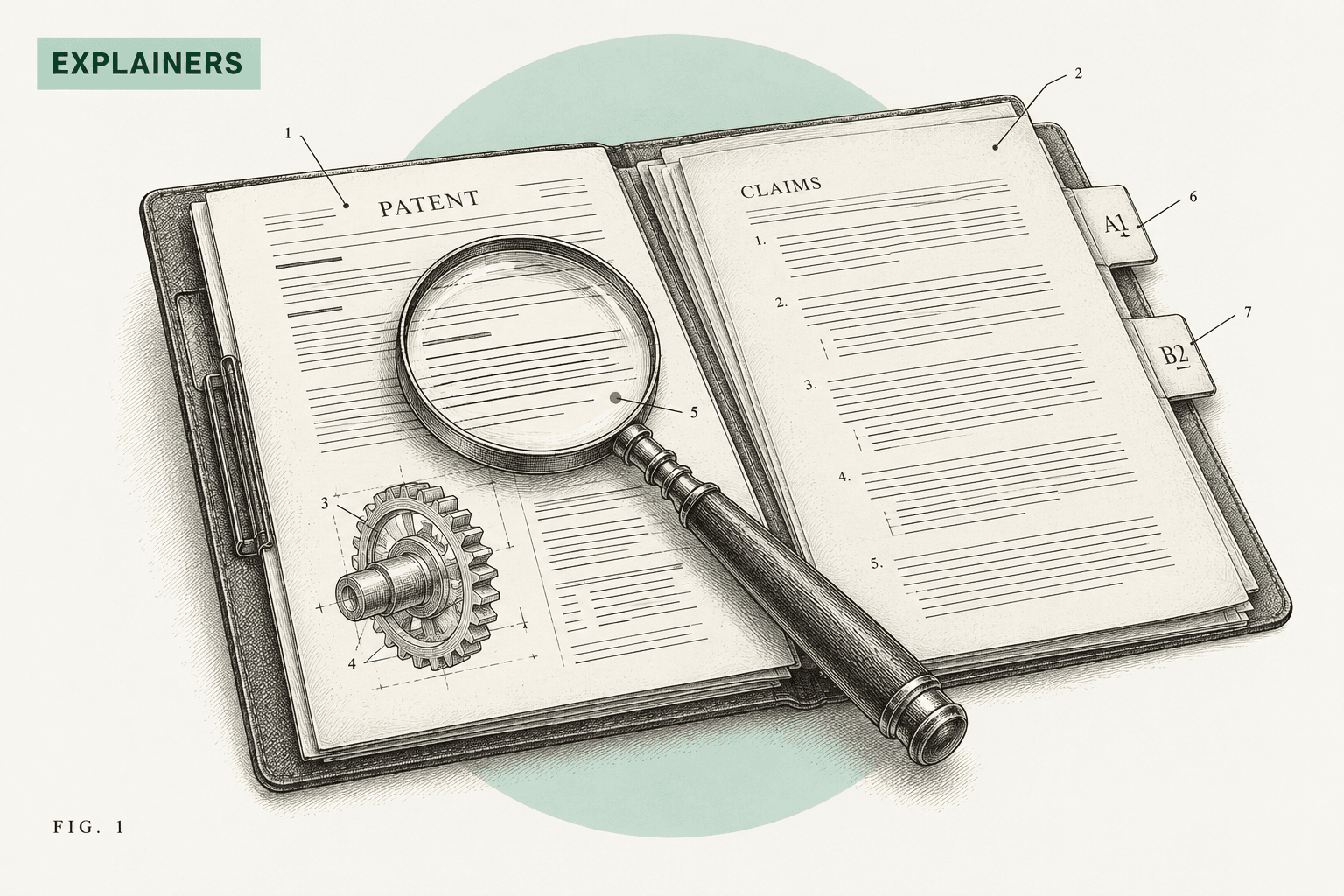
To be patentable, an invention must be new, involve an inventive step and be capable of industrial application. Those three conditions are written into Article 27(1) of the TRIPS Agreement, which requires that patents “be available for any inventions, whether products or processes, in all fields of technology,” that meet them, subject to the exclusions it allows. The United States, the European Patent Convention and Japan each state the tests in their own words, set their own exclusions and require the application to disclose the invention. More guides to the basics are on the Explainers hub.
What are the three tests?
Article 27(1) TRIPS makes patents available for inventions “provided that they are new, involve an inventive step and are capable of industrial application.” Footnote 5 adds that “the terms ‘inventive step’ and ‘capable of industrial application’ may be deemed by a Member to be synonymous with the terms ‘non-obvious’ and ‘useful’ respectively.” The footnote lets a member treat “non-obvious” and “useful”, the terms U.S. law uses, as meeting those two conditions.
The European Patent Convention uses the TRIPS wording almost word for word: European patents are granted for inventions “in all fields of technology, provided that they are new, involve an inventive step and are susceptible of industrial application” (Article 52(1) EPC). U.S. law spreads the tests across three sections: 35 U.S.C. § 101 covers anyone who “invents or discovers any new and useful process, machine, manufacture, or composition of matter,” § 102 sets out novelty and § 103 non-obviousness. Japan’s Patent Act puts all three in Article 29, starting with “an invention with industrial applicability.”
When is an invention new?
When it has not already been made available to the public and, in the United States, has not been on sale. Under Article 54 EPC, an invention is new “if it does not form part of the state of the art,” and the state of the art comprises “everything made available to the public by means of a written or oral description, by use, or in any other way, before the date of filing.” Under 35 U.S.C. § 102(a)(1), a patent is barred if the claimed invention “was patented, described in a printed publication, or in public use, on sale, or otherwise available to the public before the effective filing date.” Japan’s Article 29(1) lists inventions publicly known, publicly worked, or described in a publication or online, in Japan or abroad, before filing.
The U.S. “on sale” bar does not require the sale to be public. In Helsinn Healthcare S.A. v. Teva Pharmaceuticals USA, Inc., No. 17-1229, decided on 22 January 2019, the Supreme Court held that “a commercial sale to a third party who is required to keep the invention confidential may place the invention ‘on sale’ under the AIA.”
The date that counts can be earlier than the filing date. Article 89 EPC makes the priority date count as the filing date for Article 54, and the U.S. “effective filing date” in § 100(i) is the actual filing date or, where priority or benefit is claimed, the earliest filing to which the claim is entitled. The current U.S. § 102, from the America Invents Act, took effect on 16 March 2013.
All three systems also count certain earlier-filed applications published later. Article 54(3) EPC covers “European patent applications as filed” with earlier filing dates. Section 102(a)(2) covers U.S. patents and applications published or deemed published under § 122(b) that name another inventor and were effectively filed earlier, subject to exceptions including common ownership (§ 102(b)(2)). Japan’s Article 29-2 bars a patent for an invention identical to one described in an earlier-filed application published after the later filing, with exceptions where the inventor or the applicant is the same.
What counts as an inventive step?
An invention that would not have been obvious to a skilled person. Article 56 EPC provides: “An invention shall be considered as involving an inventive step if, having regard to the state of the art, it is not obvious to a person skilled in the art.” 35 U.S.C. § 103 bars a patent where “the claimed invention as a whole would have been obvious before the effective filing date of the claimed invention to a person having ordinary skill in the art to which the claimed invention pertains.” Japan’s Article 29(2) asks whether a person of ordinary skill “would have easily been able to make that invention.”
The test is separate from novelty. Section 103 applies “notwithstanding that the claimed invention is not identically disclosed as set forth in section 102,” so an invention can differ from every earlier disclosure and still fail if the difference would have been obvious. Article 56 EPC leaves earlier-filed, later-published European applications out of the inventive-step comparison, although Article 54(3) counts them for novelty.
What does industrial application mean?
That the invention can be made or used. Article 57 EPC states that an invention is susceptible of industrial application “if it can be made or used in any kind of industry, including agriculture.” U.S. law requires utility instead, through the words “new and useful” in § 101, and TRIPS footnote 5 lets a member treat “useful” as synonymous with “capable of industrial application.”
What subject matter is excluded?
TRIPS sets out what members may exclude. Article 27(2) lets them exclude inventions whose commercial exploitation must be prevented to protect ordre public or morality, “provided that such exclusion is not made merely because the exploitation is prohibited by their law.” Article 27(3) lets them also exclude “diagnostic, therapeutic and surgical methods for the treatment of humans or animals,” and plants and animals other than micro-organisms and essentially biological processes for producing them, though plant varieties must be protected by patents, by an effective sui generis system or by both.
The European Patent Convention takes up those options in Article 53 EPC, which bars patents for inventions whose commercial exploitation would be contrary to ordre public or morality, for plant or animal varieties and essentially biological processes (but not microbiological processes or their products), and for surgical, therapeutic and diagnostic methods practised on the body, but not for products used in those methods. Article 52(2) lists things that “shall not be regarded as inventions”: discoveries, scientific theories and mathematical methods; aesthetic creations; schemes, rules and methods for performing mental acts, playing games or doing business, and programs for computers; and presentations of information. Article 52(3) limits that exclusion to those things “as such.”
Title 35 of the U.S. Code has no list like Article 52(2). The Supreme Court reads exceptions into § 101: in Alice Corp. v. CLS Bank International, 573 U.S. 208, 216 (2014), it repeated that “Laws of nature, natural phenomena, and abstract ideas are not patentable.” Congress added one bar in the America Invents Act of 2011, set out as a note to § 101: “no patent may issue on a claim directed to or encompassing a human organism.”
Japan’s Patent Act builds one limit into its definition, since Article 2(1) defines an invention as “the highly advanced creation of technical ideas utilizing the laws of nature.” Article 32 adds that an invention “that is likely to disrupt public order, corrupt public morals or harm public health may not be patented.”
Does an inventor’s own publication count against them?
Not in the United States or Japan, within a year and on conditions. Under § 102(b)(1), a disclosure “made 1 year or less before the effective filing date” is not prior art under § 102(a)(1) if the inventor or someone who obtained the subject matter from the inventor made it. Japan’s Article 30 gives a one-year period for disclosures made against the applicant’s will (Article 30(1)) and for disclosures through the applicant’s own actions (Article 30(2)). For the applicant’s own disclosures, publication in a patent, utility model, design or trademark gazette is excluded, and the applicant must say so on filing and submit a proving document within thirty days (Article 30(3)).
The European Patent Convention is narrower. Article 55 EPC disregards a disclosure only if it “occurred no earlier than six months preceding the filing” and resulted from “an evident abuse in relation to the applicant” or from display at an “official, or officially recognised, international exhibition”; the exhibition route also needs a statement on filing and a certificate (Article 55(2)). Outside those cases, a paper, talk or product launch by the inventor before the filing or priority date is part of the state of the art under Article 54(2).
What else must an application do?
Disclose the invention. TRIPS Article 29(1) requires members to make applicants disclose the invention “in a manner sufficiently clear and complete for the invention to be carried out by a person skilled in the art,” and lets them require the best mode. In the United States, 35 U.S.C. § 112(a) requires a written description, enough detail “to enable any person skilled in the art” to make and use the invention, and the best mode contemplated by the inventor; § 112(b) requires claims “particularly pointing out and distinctly claiming” it. The explainer on full-scope enablement after Amgen v. Sanofi covers how the enablement requirement is applied.
Where do the systems differ?
The systems differ on the inventor’s own earlier disclosures: the United States and Japan disregard them for a year on the conditions above, while Article 55 EPC covers only evident abuse and recognised exhibitions, within six months.
They also draw exclusions differently. TRIPS leaves every exclusion it describes to each member, and the European list of non-inventions, the U.S. judicial exceptions and Japan’s definition of an invention and its Article 32 are each worded in their own way. Once an invention qualifies, the next question is how long protection lasts, covered in the companion explainer on how long a patent lasts.
Documents
- TRIPS Agreement, Part II, Section 5: Patents (Articles 27 to 34)
WTO legal text; patentable subject matter is Article 27, footnote 5
- 35 U.S.C. § 102, Conditions for patentability; novelty
Prior art, § 102(a); one-year exception, § 102(b)(1)
- 35 U.S.C. § 100, Definitions
Effective filing date, § 100(i)
- Alice Corp. v. CLS Bank International, 573 U.S. 208 (2014)
Supreme Court, 19 June 2014, via Legal Information Institute
- Helsinn Healthcare S.A. v. Teva Pharmaceuticals USA, Inc., No. 17-1229
Supreme Court, 22 January 2019, via Legal Information Institute
- European Patent Convention, Articles 52 to 57
Patentability, exceptions, novelty, non-prejudicial disclosures, inventive step, industrial application
- Japan Patent Act (Act No. 121 of 1959), Articles 2, 29, 29-2, 30 and 32
English translation, Japanese Law Translation database (the Japanese text governs)
Staff · Patent decisions, prosecution practice and AI in patent work
Stories under this byline are reported from the primary documents: Federal Circuit opinions, PTAB decisions, USPTO notices and European rulings.
Read more from EditorSpotted an error? Read our editorial standards and corrections policy, or send us a tip.