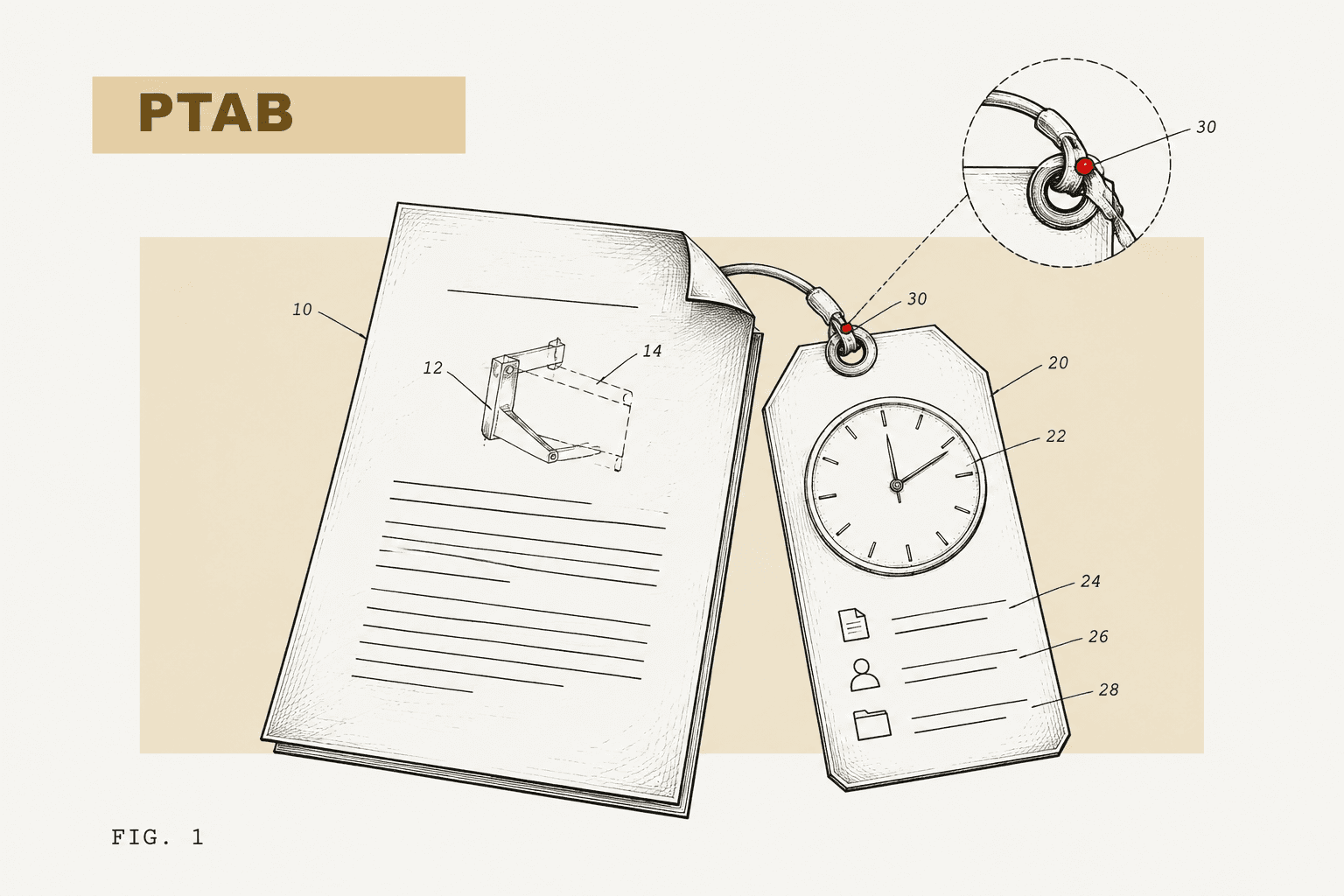
On 19 October 2026 the U.S. Court of Appeals for the Federal Circuit affirmed, in Google LLC v. Valtrus Innovations Ltd., No. 2024-1945, a Patent Trial and Appeal Board decision that Google had failed to prove any of claims 1 to 23 of U.S. Patent No. 6,728,704 unpatentable. Judge Cunningham wrote for a panel that included Judge Hughes and Judge Allison D. Burroughs of the District of Massachusetts, sitting by designation. The opinion carries no nonprecedential designation.
The appeal turned on whether a reference Google relied on was prior art at all. Every one of Google’s four obviousness grounds in IPR2022-01545 used U.S. Patent No. 6,711,569 (“Bushee”), filed on 24 July 2001, about five weeks before the application for the ’704 patent was filed on 27 August 2001. The Board found that the ’704 inventors had conceived their invention before Bushee’s filing date and worked diligently until their own filing, so Bushee was not prior art under pre-AIA 35 U.S.C. § 102(e). Without Bushee, the grounds failed. More Board appeals are collected on the PTAB hub.
What did the court say about corroboration?
The panel held that metadata automatically generated by Microsoft Word is “independent of [an inventor’s] own statements and documents” and can corroborate inventor testimony. Google had argued that the co-inventor’s declaration, the original invention-disclosure documents and the metadata attached to those documents were all under the inventor’s control and so could not supply the independent corroboration that Apator Miitors v. Kamstrup (2018) requires. The court disagreed, citing its 2025 decision in Global Health Solutions v. Selner for the proposition that software-generated metadata is not authored by the inventor.
The opinion distinguishes the metadata from “unwitnessed laboratory notebooks” and “unwitnessed emails and drawings,” which under Apator and Stern v. Columbia (2006) cannot corroborate an inventor’s testimony on their own. The authorship and timestamp information in the metadata was consistent with the conception date the inventor identified, and the court noted that Google’s counsel acknowledged at oral argument that a human is not a required element for corroboration. Applying the rule of reason, the panel found substantial evidence for the Board’s conclusion that the disclosure documents and metadata provided “separate corroboration” of the declaration.
One limit is stated expressly. The court assumed “without deciding the metadata’s authenticity.” One reading is that a challenger able to show metadata was altered or unreliable would be making a different argument from the one Google lost. The parties treated the alleged conception date as confidential, and the opinion does not state it.
How was diligence shown across the gap?
Google disputed only the period from 8 August 2001, when the last inventor signed the declaration, to the 27 August 2001 filing, which it described as about 11 business days. The Board found that the co-inventor was in Ontario, Canada, so the physical signature had to travel by mail to the law firm’s California office, and credited Valtrus’s expert, Dr. Cole, who explained that finalising an application for filing takes law firms “on the order of several weeks or more.” The court called these “non-speculative facts” sufficient to support the finding that the invention “was not abandoned or unreasonably delayed.”
The panel rejected Google’s reliance on In re Mulder (1983), which Google read as a case where a two-day gap defeated diligence. In Mulder, the court said, a draft U.S. application had been prepared for nearly three months and yet the record showed “no activity of any kind in this country,” and the Mulder opinion itself warned that focusing on the shortness of the gap was misleading. Here Valtrus accounted for the entire critical period with timestamp evidence of inventors and a law firm working to complete, execute and file the application. Diligence, the court repeated from Arctic Cat v. GEP Power Products (2019), “need not be perfectly continuous—only reasonably continuous.”
Why does a pre-AIA case matter now?
Because patents filed before 16 March 2013 remain in litigation and in inter partes review, and because the corroboration rules the court applied are not confined to swearing behind a reference. The same rule-of-reason analysis governs inventorship disputes and derivation, and the holding that machine-generated metadata counts as independent evidence may be cited wherever an inventor’s account needs support. The decision also shows how much can turn on a reference’s status: once the Board found Bushee was not prior art, it concluded that Google had not carried its burden on any claim.
Practitioners may consider the evidentiary side of this outcome. Valtrus prevailed with original disclosure files, their native metadata, a co-inventor declaration and an expert who explained ordinary filing timelines. Patent owners preserving pre-AIA priority evidence, and challengers planning to contest it, may both weigh how native files and their metadata are kept, produced and authenticated. The Federal Circuit hub carries related decisions on evidence and procedure.
Background
The ’704 patent, titled “Method and apparatus for merging result lists from multiple search engines,” claims methods and computer-readable memory for merging result lists returned by several search engines: selecting a subset of entries from each list, scoring them, assigning each subset a representative value and producing a merged list. Google petitioned for review of all 23 claims on four grounds, each combining Bushee with Voorhees, alone or together with Koppel and/or Tso. Nathan R. Speed of Wolf, Greenfield & Sacks argued for Google; Philip J. Warrick of Irell & Manella argued for Valtrus. The court heard argument on 4 March 2026.
Documents
- Opinion, Google LLC v. Valtrus Innovations Ltd., No. 2024-1945
Fed. Cir. Oct. 19, 2026, precedential
- 35 U.S.C. § 102
Current text; the pre-AIA version of § 102(e) governed this appeal
Staff · Patent decisions, prosecution practice and AI in patent work
Stories under this byline are reported from the primary documents: Federal Circuit opinions, PTAB decisions, USPTO notices and European rulings.
Read more from EditorSpotted an error? Read our editorial standards and corrections policy, or send us a tip.