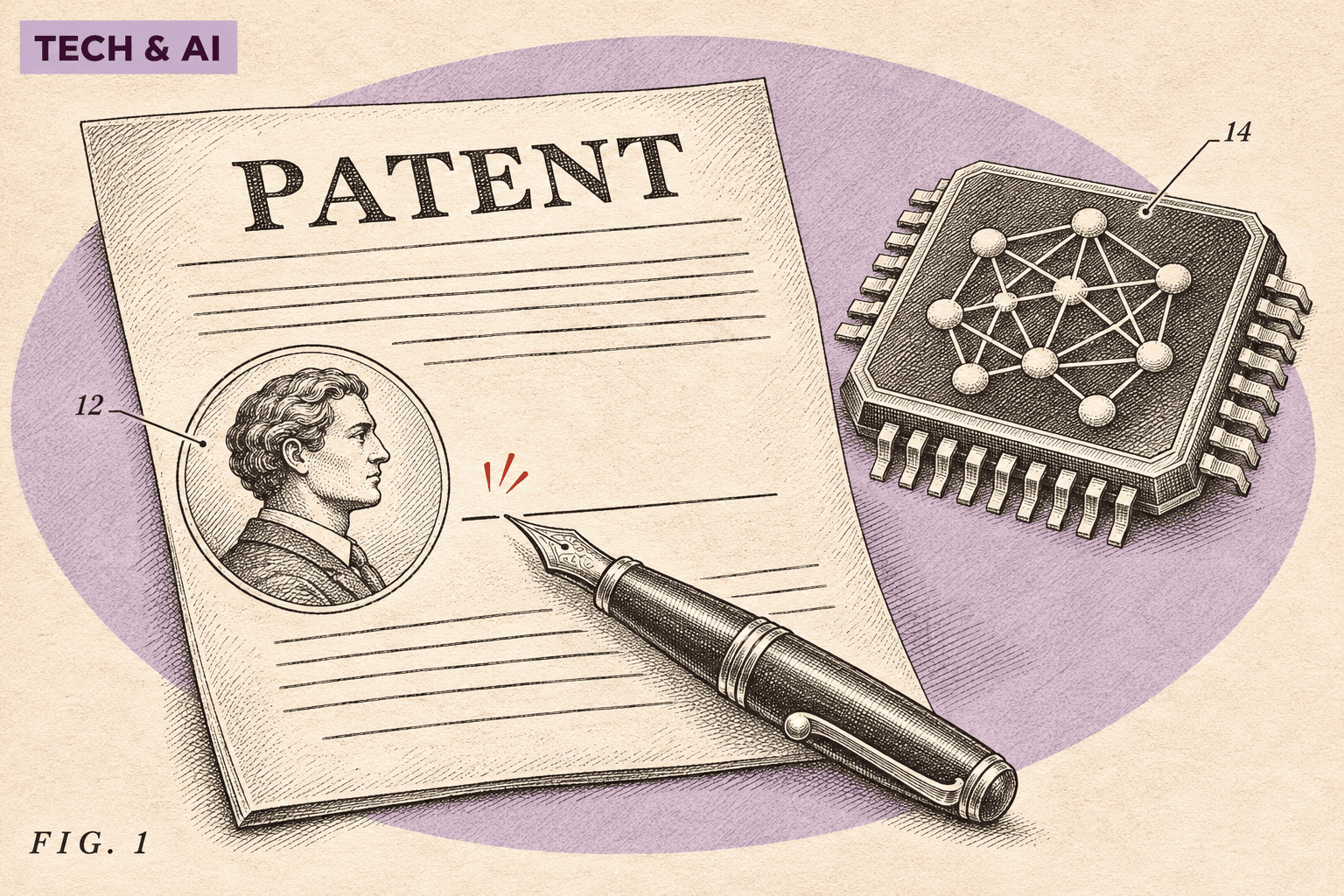
AI inventorship is the question whether an artificial intelligence system can be named as the inventor on a patent application. The courts of the United States, the United Kingdom and Germany, and the European Patent Office’s Legal Board of Appeal, have each held that an inventor must be a natural person. The leading decisions arose from applications by Stephen Thaler naming his AI system, DABUS, as inventor; the UK Supreme Court described the UK applications as “part of a project involving parallel applications by Dr Thaler to patent offices around the world” (para 3). More on AI and patents is on the Tech & AI hub.
Can an AI system be named as an inventor in the United States?
No. In Thaler v. Vidal, No. 2021-2347 (Fed. Cir. Aug. 5, 2022) (precedential), the Federal Circuit affirmed a judgment upholding the USPTO’s denial of two applications that “failed to list any human as an inventor.” Judge Stark wrote for a panel with Chief Judge Moore and Judge Taranto: “Here, there is no ambiguity: the Patent Act requires that inventors must be natural persons; that is, human beings.” (Slip op. 2, 5.)
The court rested on the text. 35 U.S.C. § 100(f) defines an inventor as “the individual or, if a joint invention, the individuals collectively who invented or discovered the subject matter of the invention,” and the court read “individual” as a human being. It concluded: “Congress has determined that only a natural person can be an inventor, so AI cannot be.” It noted Thaler’s point that South Africa had granted patents naming DABUS, and said that office “was not interpreting our Patent Act.” (Slip op. 6, 11.)
The court set one question aside: “we are not confronted today with the question of whether inventions made by human beings with the assistance of AI are eligible for patent protection.” (Slip op. 10.)
What does the USPTO’s 2025 inventorship guidance say?
That AI-assisted inventions are judged by the ordinary standard. In a notice published in the Federal Register on 28 November 2025 (90 FR 54636), the USPTO rescinded its February 2024 Inventorship Guidance for AI-Assisted Inventions “in its entirety” and withdrew its approach, “which relied on the application of the Pannu factors to AI-assisted inventions.” The notice states: “The same legal standard for determining inventorship applies to all inventions, regardless of whether AI systems were used in the inventive process. There is no separate or modified standard for AI-assisted inventions.”
The standard is conception, which the notice calls “the touchstone of inventorship,” quoting Federal Circuit precedent. It describes AI systems as “instruments used by human inventors,” “analogous to laboratory equipment, computer software, research databases, or any other tool that assists in the inventive process.” Where one natural person uses AI, “the inquiry is whether that person conceived the invention under the traditional conception standard.”
The notice starts from the inventors named in the application data sheet or oath or declaration, whom the USPTO “presumes” are the actual inventors, and addresses an AI named among them: “A rejection under 35 U.S.C. 101 and 115, or other appropriate action, should be made for all claims in any application that lists an AI system or other non-natural person as an inventor or joint inventor.” It applies to design and plant applications as well as utility applications.
How does the guidance treat joint inventors and priority claims?
Joint inventorship among people is unchanged. Where several natural persons work with AI, the notice applies “the traditional joint inventorship principles,” including the Pannu factors, and says “The fact that AI tools were used in the development process does not change the joint inventorship analysis among the human contributors.” The Pannu factors no longer apply where one person works with AI, because AI systems “cannot be ‘joint inventors.’”
Priority claims must link natural persons. Under Section VI of the notice, “a priority claim to a foreign application that names an AI tool as the sole inventor will not be accepted.” Where a foreign application names both people and a non-natural person, the U.S. application data sheet “must list only the natural person(s) identified as the inventor(s), including one in common with the foreign application,” and the same approach applies on national stage entry. The explainer on the priority year covers how priority works.
What did the UK Supreme Court decide?
That DABUS could not be the inventor and Thaler could not claim through it. In Thaler v Comptroller-General of Patents, Designs and Trade Marks [2023] UKSC 49, decided on 20 December 2023, Lord Kitchin, with whom Lords Hodge, Hamblen, Leggatt and Richards agreed, held that sections 7 and 13 of the Patents Act 1977 “permit only one interpretation: an inventor within the meaning of the 1977 Act must be a natural person, and DABUS is not a person at all, let alone a natural person.” The court dismissed the appeal, so the applications are deemed withdrawn. (Paras 56, 99.) The UKIPO’s Manual of Patent Practice (13.10.1) records the rule that an inventor must be a natural person.
The judgment marks its limits. The appeal “is not concerned with the broader question whether technical advances generated by machines acting autonomously and powered by AI should be patentable.” And: “it is not and has never been Dr Thaler’s case that he was the inventor and used DABUS as a highly sophisticated tool. Had he done so, the outcome of these proceedings might well have been different.” (Paras 48, 52.)
What is the position at the European Patent Office?
The same. In J 8/20, decided on 21 December 2021, the Legal Board of Appeal dismissed the appeal on one of Thaler’s DABUS applications and refused to refer questions to the Enlarged Board; its catchword reads: “A machine is not an inventor within the meaning of the EPC.” The EPO’s 2026 Guidelines (A-III, 5.1) state: “Every application must designate the inventor, who must be a natural person (J 8/20).” Under A-III, 5.3, the EPO “does not verify the accuracy of the information given in the designation of the inventor but checks whether the designated inventor is a natural person.”
What did Germany’s Federal Court of Justice decide?
In its decision of 11 June 2024, X ZB 5/22 (DABUS), the Bundesgerichtshof stated in its first headnote that an inventor under § 37(1) of the Patent Act “kann nur eine natürliche Person sein” (can only be a natural person), and that a machine system cannot be named even if it has AI functions. Its second headnote says naming a natural person is possible and required even where an AI system was used to arrive at the claimed teaching.
The other two headnotes, in translation, turn on wording. Naming a natural person on the official form does not satisfy § 37(1) if the applicant at the same time asks for the description to state that the invention was generated or created by AI. But adding to a sufficiently clear designation that the named inventor caused a specified AI to generate the invention is legally irrelevant and does not justify refusing the application under § 42(3).
Do these decisions say AI-assisted inventions cannot be patented?
No. Each addresses who may be named as inventor. The Federal Circuit said it was not deciding whether inventions made by people with AI assistance are eligible; the UK Supreme Court said the appeal was not about whether AI-generated advances should be patentable; the USPTO’s 2025 notice asks whether a natural person conceived the invention; and the German court held that a natural person must be named even where AI was used. The other conditions for a patent, covered in the explainer on what makes an invention patentable, apply as usual.
What follows for naming inventors?
On the documents, in each of the four forums covered here the person named must be a natural person who meets that forum’s inventorship standard; in the United States, the 2025 notice applies the conception standard, and the Pannu factors among joint inventors. Under the notice, a U.S. application claiming priority from a foreign filing that names both people and an AI as joint inventors must list only the natural persons in its application data sheet, with at least one in common; a priority claim to a filing naming an AI as sole inventor “will not be accepted.” In Germany, the BGH’s headnotes distinguish a statement that the named person caused an AI to generate the invention, which it held irrelevant, from naming a person while also asking for the description to state that the invention was AI-generated, which it held does not satisfy § 37(1).
Documents
- Thaler v. Vidal, No. 2021-2347
Fed. Cir. Aug. 5, 2022, precedential; 43 F.4th 1207
- USPTO, Revised Inventorship Guidance for AI-Assisted Inventions, 90 FR 54636
Federal Register, Nov. 28, 2025; FR Doc. 2025-21457
- Thaler v Comptroller-General of Patents, Designs and Trade Marks [2023] UKSC 49
UK Supreme Court, 20 Dec. 2023
- EPO Legal Board of Appeal, J 8/20 (DABUS)
21 Dec. 2021
- Bundesgerichtshof, X ZB 5/22 (DABUS), on WIPO Lex
11 June 2024; German
Staff · Patent decisions, prosecution practice and AI in patent work
Stories under this byline are reported from the primary documents: Federal Circuit opinions, PTAB decisions, USPTO notices and European rulings.
Read more from EditorSpotted an error? Read our editorial standards and corrections policy, or send us a tip.