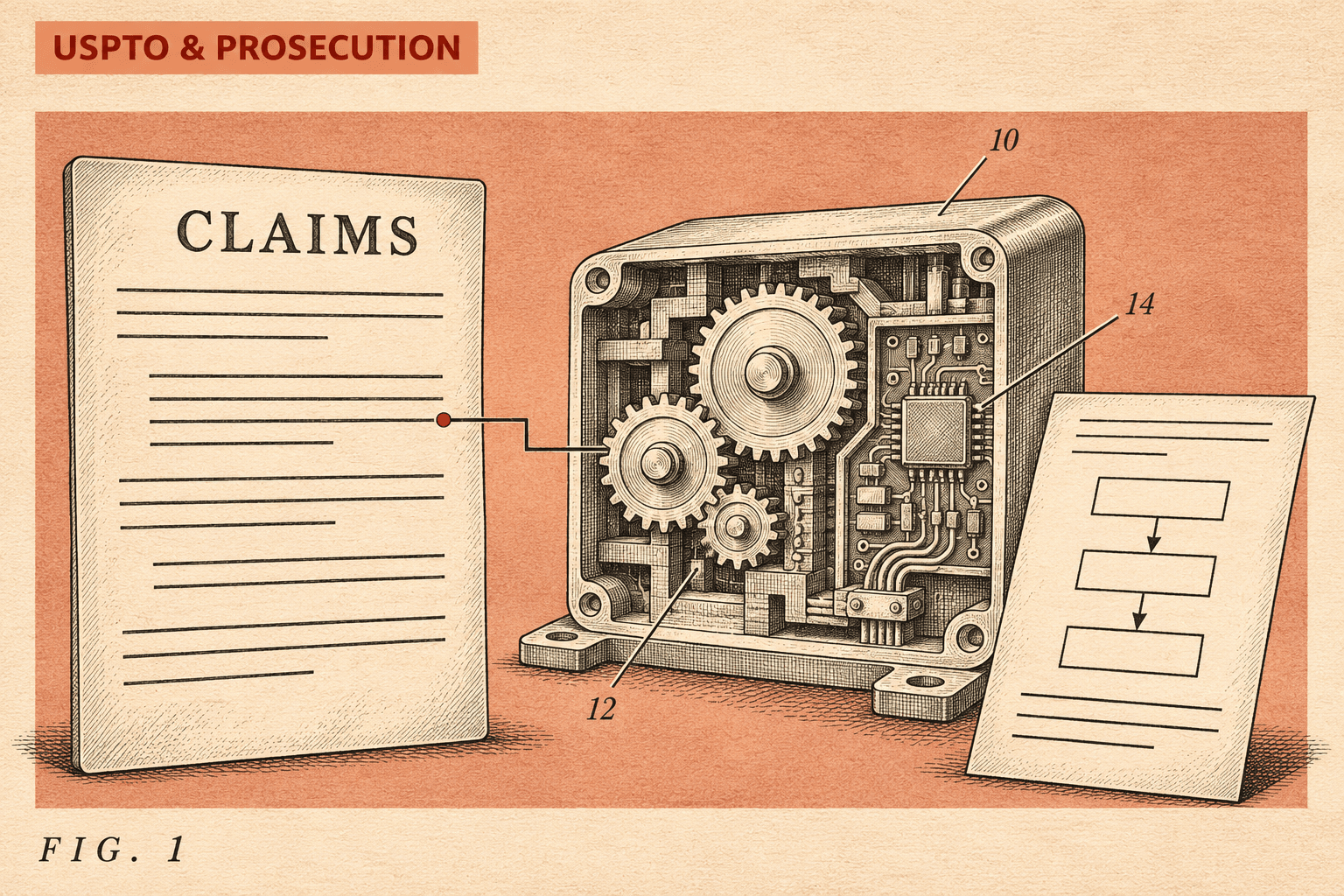
A means-plus-function claim limitation is one that states a function without the structure that performs it, and 35 U.S.C. § 112(f) then confines it to the structure in the specification and its equivalents. The statute provides that such an element “may be expressed as a means or step for performing a specified function without the recital of structure, material, or acts in support thereof,” and that “such claim shall be construed to cover the corresponding structure, material, or acts described in the specification and equivalents thereof.” Since Williamson v. Citrix Online, No. 2013-1130 (Fed. Cir. 2015), a limitation without the word “means” can fall under that rule without any heightened showing. More on drafting and prosecution is on the USPTO & Prosecution hub.
What did Williamson v. Citrix change?
It removed a heightened bar. In a nonprecedential order of 16 June 2015, the Federal Circuit granted rehearing en banc “for the limited purpose of overruling certain prior precedent regarding the application of 35 U.S.C. § 112, para. 6,” the pre-AIA version of § 112(f). Judge Linn’s substitute panel opinion states that its Part II.C.1 “has been considered and decided by the court en banc.” Eleven judges joined that part; Judge Newman dissented from it.
Earlier decisions, beginning with Lighting World v. Birchwood Lighting (2004), had called the presumption against § 112(f) for terms lacking “means” “a strong one that is not readily overcome.” Williamson held that characterization “is unwarranted, is uncertain in meaning and application, and has the inappropriate practical effect of placing a thumb on what should otherwise be a balanced analytical scale.” The court wrote that it would “expressly overrule the characterization of that presumption as ‘strong,’” and also overruled “the strict requirement of ‘a showing that the limitation essentially is devoid of anything that can be construed as structure.’” (Slip op. 14 to 16.)
When does a claim term without “means” invoke § 112(f)?
When it does not name a structure to the skilled reader. Williamson states the test: “The standard is whether the words of the claim are understood by persons of ordinary skill in the art to have a sufficiently definite meaning as the name for structure.” A term without “means” is presumed outside § 112(f), but the presumption is overcome if the term fails to “recite sufficiently definite structure” or recites “function without reciting sufficient structure for performing that function.” The converse presumption, that “means” invokes § 112(f), “remains unaffected.” (Slip op. 16.)
What is a nonce word?
A generic word that stands in for “means.” In a part of the opinion decided by the panel rather than the en banc court, the panel wrote: “‘Module’ is a well-known nonce word that can operate as a substitute for ‘means’ in the context of § 112, para. 6.” Terms such as “mechanism,” “element” and “device” may do the same because they “typically do not connote sufficiently definite structure.” (Slip op. 17.)
Claim 8 of U.S. Patent No. 6,155,840 recited a “distributed learning control module for receiving communications transmitted between the presenter and the audience member computer systems,” for relaying them and for coordinating a streaming data module. The court found the passage “in a format consistent with traditional means-plus-function claim limitations,” and that “module” gave “the same black box recitation of structure for providing the same specified function as if the term ‘means’ had been used.” The prefix “distributed learning control” did “not impart structure.” (Slip op. 17 to 18.)
How does the USPTO decide whether § 112(f) applies?
By a three-prong test in MPEP § 2181. Examiners apply § 112(f) when (A) the limitation uses “means,” “step” or a generic placeholder “for performing the claimed function”; (B) that term is modified by functional language, “typically, but not always linked by the transition word ‘for’ (e.g., ‘means for’) or another linking word or phrase, such as ‘configured to’ or ‘so that’”; and (C) it is not modified by sufficient structure, material or acts for performing the function.
The MPEP lists placeholders that may invoke § 112(f): “‘mechanism for,’ ‘module for,’ ‘device for,’ ‘unit for,’ ‘component for,’ ‘element for,’ ‘member for,’ ‘apparatus for,’ ‘machine for,’ or ‘system for.’” It adds that “there is no fixed list of generic placeholders that always result in 35 U.S.C. 112(f) interpretation, and likewise there is no fixed list of words that always avoid” it. It also states that application of § 112(f) “is driven by the claim language, not by applicant’s intent.”
MPEP § 2181 says a § 112(f) interpretation “should be expressly stated in the examiner’s Office action.” An applicant who disagrees may show that the limitation recites sufficient structure or amend it, for example “by reciting sufficient structure to perform the claimed function.” Where it is unclear whether § 112(f) applies, “a rejection under 35 U.S.C. 112(b) may be appropriate.”
Do software terms like “code” or “handler” invoke § 112(f)?
It depends on the evidence of what the term means to the skilled reader. MPEP § 2181 notes that “code” and “application” were found not to be generic placeholders in Dyfan v. Target (Fed. Cir. 2022), where the skilled reader would understand them, with their functions, “as connoting structure.” The same section cites Zeroclick v. Apple (Fed. Cir. 2018) for “program” and “user interface code.”
In Fintiv v. PayPal Holdings, No. 2023-2312 (Fed. Cir. Apr. 30, 2025) (precedential), the court reached the opposite result for “payment handler.” The claims recited, among other things, “a payment handler that exposes a common API for interacting with different payment processors.” The court held that the terms “recite function without reciting sufficient structure for performing that function” and agreed that “handler” was analogous to “module.” It distinguished Dyfan because there the challenger’s own expert testified, unrebutted, that “code” and “application” connoted a class of structures, while in Fintiv “neither expert testified that the payment-handler terms connoted structure.” (Slip op. 6 to 10.)
What must the specification disclose?
Structure for every claimed function. Williamson describes a two-step process: the court “must first identify the claimed function” and then “determine what structure, if any, disclosed in the specification corresponds to the claimed function.” Where several functions are claimed, “the patentee must disclose adequate corresponding structure to perform all of the claimed functions,” and if the patentee fails to do so, “the claim is indefinite.” (Slip op. 20.)
For functions a special-purpose computer must perform, that structure is an algorithm. Williamson states: “We require that the specification disclose an algorithm for performing the claimed function,” and “The algorithm may be expressed as a mathematical formula, in prose, or as a flow chart, or in any other manner that provides sufficient structure.” Expert testimony “cannot supplant the total absence of structure from the specification.” (Slip op. 22, 24.)
MPEP § 2181 quotes EON Corp. v. AT&T Mobility (Fed. Cir. 2015) for one exception: a general-purpose computer “lends sufficient structure only to basic functions of a microprocessor,” such as “‘receiving’ data, ‘storing’ data, and ‘processing’ data,” and “All other computer-implemented functions require disclosure of an algorithm.” It also quotes Aristocrat v. International Game Technology (Fed. Cir. 2008): the patentee there “was not required to produce a listing of source code or a highly detailed description of the algorithm.”
How did the specifications fare in Williamson and Fintiv?
Both failed. In Williamson, the patentee pointed to Figures 4 and 5 of the ’840 patent; the court found each was “a description of a presenter display interface; it is not a disclosure of an algorithm,” and affirmed that claims 8 to 16 were invalid for indefiniteness under § 112, paragraph 2. (Slip op. 22 to 25.) How the Federal Circuit keeps indefiniteness and enablement apart under § 112 is the subject of the Satius v. Samsung story.
In Fintiv, the court found that the specifications’ only textual support for the terms “merely parrots the claim language,” a point it made in finding that § 112 ¶ 6 applied, and that Fintiv’s proposed “two-step algorithm merely recites the asserted claims’ language.” Applying Aristocrat, it said that describing “the results of the operation of an unspecified algorithm” was not enough, and held the payment-handler terms indefinite. The court affirmed. (Slip op. 10 to 13.)
What may drafters take from the cases?
The placeholders and linking words (“for,” “configured to,” “so that”) are what MPEP § 2181’s three-prong test identifies. Where a term is drafted in functional form, Williamson accepts an algorithm “in prose, or as a flow chart,” and Fintiv shows that a specification restating the claim does not supply one. Where a term is said to name structure, Dyfan and Fintiv suggest that the record on how skilled readers understand it, including expert testimony, can decide the question; the guide to reading a patent covers how claims and specification relate.
Documents
- Williamson v. Citrix Online, LLC, No. 2013-1130, opinion
Fed. Cir. June 16, 2015, precedential; Part II.C.1 en banc; 792 F.3d 1339
- Williamson v. Citrix Online, LLC, No. 2013-1130, order on rehearing en banc
Fed. Cir. June 16, 2015, nonprecedential order
- Fintiv, Inc. v. PayPal Holdings, Inc., No. 2023-2312
Fed. Cir. Apr. 30, 2025, precedential
- 35 U.S.C. § 112, Specification
§ 112(f)

Staff · Patent decisions, prosecution practice and AI in patent work
Stories under this byline are reported from the primary documents: Federal Circuit opinions, PTAB decisions, USPTO notices and European rulings.
Read more from EditorSpotted an error? Read our editorial standards and corrections policy, or send us a tip.