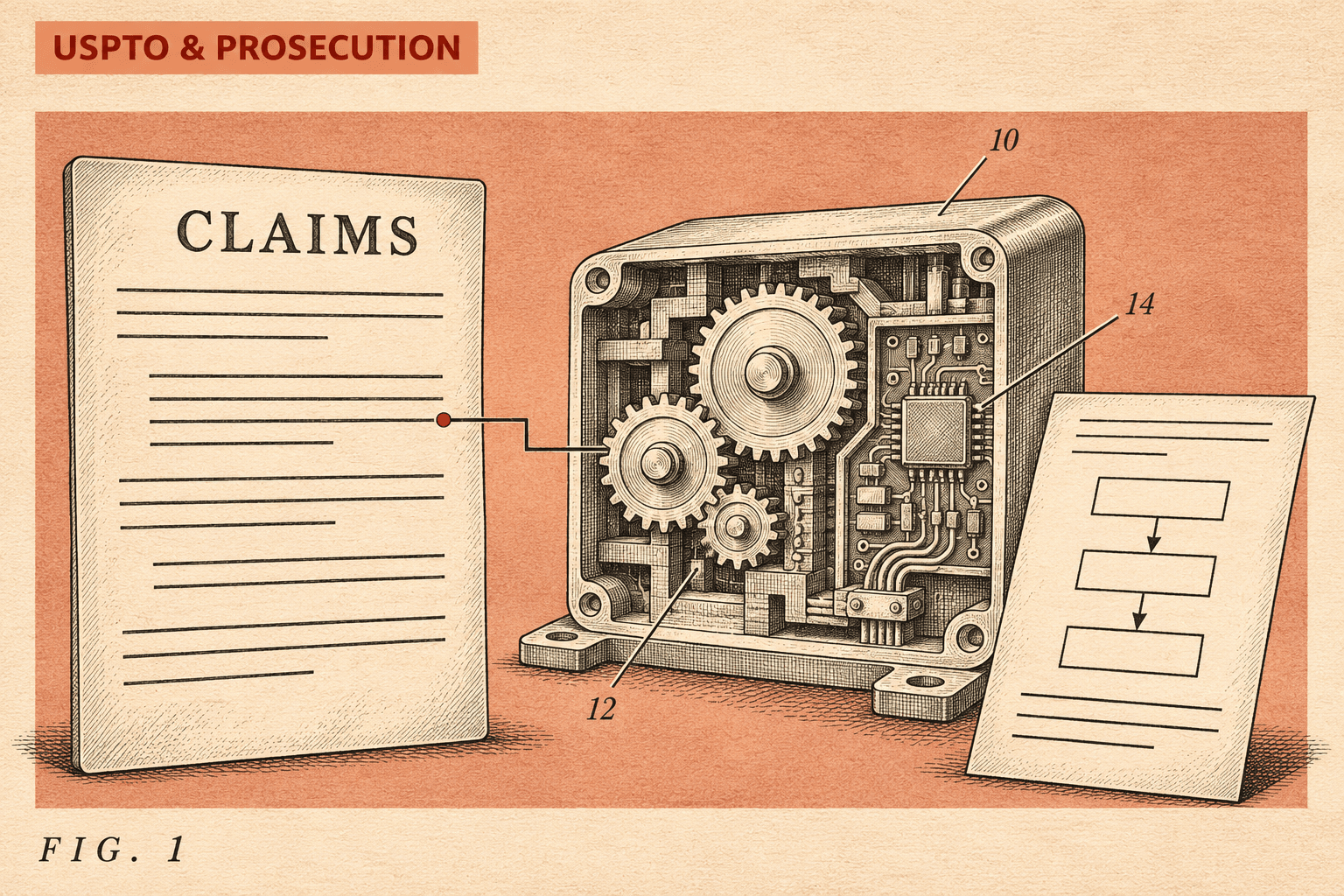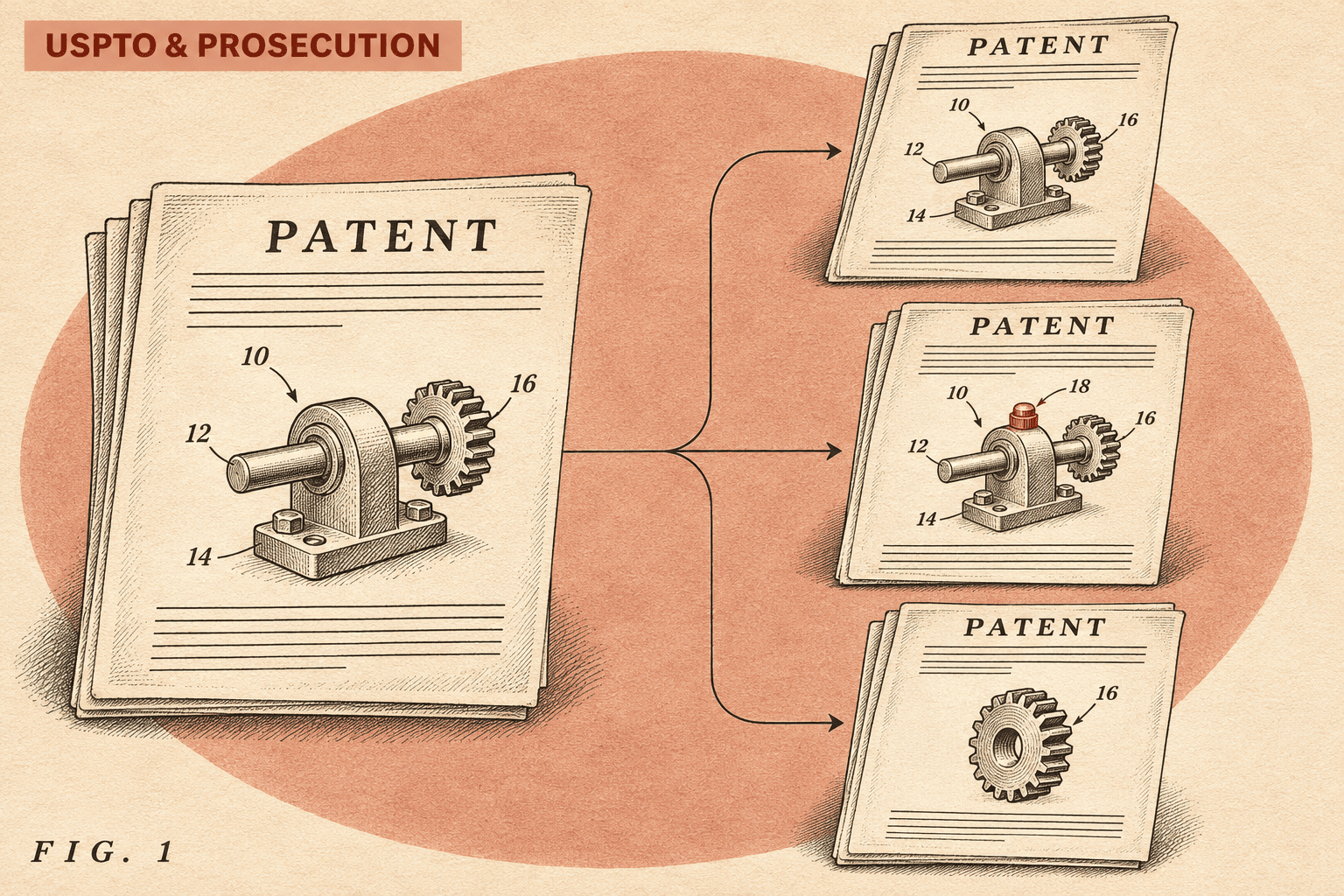
A continuation, a continuation-in-part (CIP) and a divisional are the three kinds of continuing application in U.S. practice: later applications that claim the filing date of a copending parent application. The Manual of Patent Examining Procedure (MPEP § 201.02) defines a continuing application as “a continuation, divisional, or continuation-in-part application filed under the conditions specified in 35 U.S.C. 120, 121, 365(c), or 386(c) and 37 CFR 1.78.” More prosecution practice is on the USPTO & Prosecution hub.
What is the difference between a continuation, a CIP and a divisional?
A continuation pursues new claims on the parent’s disclosure, without new matter. A continuation-in-part repeats a substantial portion or all of the parent and adds new matter, and only the claims the parent supports keep the parent’s date. A divisional claims an independent or distinct invention carved out of the parent, often after the examiner requires restriction.
What must every continuing application satisfy?
The conditions in 35 U.S.C. § 120. The later application must claim an invention disclosed in the earlier one “in the manner provided by section 112(a) (other than the requirement to disclose the best mode)”; it must name an inventor or joint inventor named in the earlier application; it must be filed “before the patenting or abandonment of or termination of proceedings on the first application” or on an application similarly entitled to its date; and it must contain “a specific reference to the earlier filed application.”
The rules set the form and the deadline. Under 37 CFR § 1.78(d)(2), the reference goes in an application data sheet and “must identify the relationship of the applications, namely, whether the later-filed application is a continuation, divisional, or continuation-in-part.” For an application filed under § 111(a), MPEP § 211.03 says the reference must be submitted “within the later of four months from the actual filing date of the application or sixteen months from the filing date of the prior application.”
Section 120 lets the Director treat a late reference as “a waiver of any benefit under this section,” and lets the Office accept “an unintentionally delayed submission” on payment of a fee. The Office’s 2026 change to those petitions is covered in the story on the one-year unintentional-delay rule.
What is a continuation application?
The parent’s disclosure, without new matter, with different claims. MPEP § 201.07 defines it as “an application for the invention(s) disclosed in a prior-filed copending nonprovisional application,” or in a copending international application designating the United States, and says its disclosure “must not include any subject matter which would constitute new matter if submitted as an amendment to the parent application.” Its inventorship must include at least one inventor named in the parent.
Before the parent is patented or abandoned, MPEP § 201.07 says, an applicant may file one “in order to introduce into the application a new set of claims and to establish a right to further examination by the Office.”
What is a continuation-in-part?
An application that adds to the parent. MPEP § 201.08 defines it as “an application filed during the lifetime of a prior-filed nonprovisional application,” or a copending international application designating the United States, “repeating some substantial portion or all of the prior-filed application and adding matter not disclosed in the prior-filed application.” It may be filed only under 37 CFR § 1.53(b).
Does a continuation-in-part get the parent’s filing date?
Claim by claim. MPEP § 211.05 states: “Only the claims of the continuation-in-part application that are disclosed in the manner provided by 35 U.S.C. 112(a) in the prior-filed application are entitled to the benefit of the filing date of the prior-filed application.” A claim that recites a feature first introduced or first adequately supported in the CIP “is entitled only to the filing date of the continuation-in-part application,” citing In re Chu (Fed. Cir. 1995) and Transco Products v. Performance Contracting (Fed. Cir. 1994).
The later date matters for prior art. The same section says that if claims entitled only to the CIP’s date “read on” subject matter published, publicly used, sold or patented, as in a genus-species relationship, a rejection under § 102 “would be proper.” MPEP § 201.08 adds that the Office need not decide whether the parent supports a CIP’s claims “unless the filing date of the earlier nonprovisional application is relied upon in a proceeding before the Office.”
How does the Federal Circuit test a chain of earlier dates?
Link by link. In Regents of the University of Minnesota v. Gilead Sciences, No. 21-2168 (Fed. Cir. Mar. 6, 2023) (precedential), the court quoted Lockwood v. American Airlines: to receive the benefit of an earlier date under § 120, “each application in the chain leading back to the earlier application must comply with the written description requirement of 35 U.S.C. § 112.” (Slip op. 7.)
The application that issued as U.S. Patent No. 8,815,830 was filed on 28 March 2014 and claimed priority from four applications: a provisional (9 December 2004), an international application (8 December 2005) and U.S. applications filed in 2007 and 2013. The 2013 filing postdated a patent application publication to Sofia, published on 21 January 2010, and the 2007 filing had the same disclosure as the international application, so the Patent Trial and Appeal Board assessed the 2004 and 2005 filings. (Slip op. 4 to 5.)
The Board held that those two did not provide written description for the challenged claims, which were therefore “not entitled to a priority date earlier than their own filing date of March 28, 2014,” and were anticipated by Sofia. The Federal Circuit affirmed. (Slip op. 5, 11, 14.)
What is a divisional application?
An application for a second invention the parent disclosed. MPEP § 201.06 describes it as “a later application for an independent or distinct invention, carved out of” a nonprovisional or international application “and disclosing and claiming only subject matter disclosed in the earlier or parent application.” It adds that “a divisional application is often filed as a result of a restriction requirement made by the examiner.”
The statute behind it is 35 U.S.C. § 121. If “two or more independent and distinct inventions are claimed in one application,” the Director may require restriction to one, and a divisional on another that complies with § 120 is “entitled to the benefit of the filing date of the original application.”
Which applications get the § 121 safe harbor?
Divisional and original applications in a family split by an Office restriction requirement. Section 121 says a patent issuing on an application subject to a restriction requirement, or filed as a result of one, “shall not be used as a reference either in the Patent and Trademark Office or in the courts against a divisional application or against the original application or any patent issued on either of them,” provided the divisional is filed before the other patent issues.
MPEP § 804.01 sets the limits. The prohibition on nonstatutory double patenting rejections “applies only where the Office has made a requirement for restriction,” and not where a divisional “was voluntarily filed by the applicant.” The claims must also stay consonant with the restriction: the line the examiner drew between the inventions “must be maintained.”
It does not reach continuations or CIPs. MPEP § 1481.03 states that the safe harbor “only protects divisional applications, not continuation applications or continuation-in-part applications,” citing Pfizer v. Teva (Fed. Cir. 2008) and Amgen v. Hoffmann-La Roche (Fed. Cir. 2009). In Pfizer, quoted in MPEP § 804.01, the court said that “the protection afforded by section 121 to applications (or patents issued therefrom) filed as a result of a restriction requirement is limited to divisional applications.” Under G.D. Searle v. Lupin (Fed. Cir. 2015) and In re Janssen Biotech (Fed. Cir. 2018), a patentee cannot recover it afterwards by amending a patent that issued from a CIP down to the parent’s subject matter and redesignating it a divisional.
Outside the safe harbor, a nonstatutory double patenting rejection remains available. MPEP § 804.02 notes that a terminal disclaimer filed “to obviate” one “is not an admission of the propriety of the rejection.”
How long does a patent from each one last?
For utility patents the rule is the same for all three. Section 154(a)(2) ends the term 20 years from the U.S. filing date or, if the application refers to earlier applications under §§ 120, 121, 365(c) or 386(c), “from the date on which the earliest such application was filed.” For a CIP that is the parent’s date or an earlier one, even where its new-matter claims take the CIP’s own date for prior art; under § 154(a)(3), foreign priority and provisional benefit under § 119 do not count. A design patent filed since 13 May 2015 runs 15 years from grant under § 173; the explainer on patent term covers both.
What does the MPEP say not to call them?
Two things. A continuation-in-part “should not be designated as a divisional application” (MPEP § 201.06). An application that claims the benefit of a provisional under § 119(e) is not a continuing application of it: MPEP § 201.08 says it “claims the benefit of the provisional application and is not a continuation, division, or continuation-in-part of the provisional application.” A separate filing rule: a CIP “CANNOT be filed as a continued prosecution application” under 37 CFR § 1.53(d), a route MPEP § 201.07 limits to design applications other than international design applications.
How does Europe treat divisional applications?
Under Article 76(1) EPC, a European divisional “may be filed only in respect of subject-matter which does not extend beyond the content of the earlier application as filed,” and to that extent is deemed filed on the parent’s date. The condition in Article 76(1) excludes what defines a CIP in U.S. practice: matter beyond the parent as filed.
Documents
- 35 U.S.C. § 154, Contents and term of patent
§ 154(a)(2) and (a)(3)
- MPEP § 201, Types of Applications
§§ 201.02, 201.06, 201.07, 201.08
- MPEP § 211, Claiming the Benefit of an Earlier Filing Date
§§ 211.03, 211.05
- MPEP § 804, Definition of Double Patenting
§§ 804.01, 804.02
- Regents of the University of Minnesota v. Gilead Sciences, Inc., No. 21-2168
Fed. Cir. Mar. 6, 2023, precedential

Staff · Patent decisions, prosecution practice and AI in patent work
Stories under this byline are reported from the primary documents: Federal Circuit opinions, PTAB decisions, USPTO notices and European rulings.
Read more from EditorSpotted an error? Read our editorial standards and corrections policy, or send us a tip.